
Advanced Cancer Treatment Technologies, Personalized for You
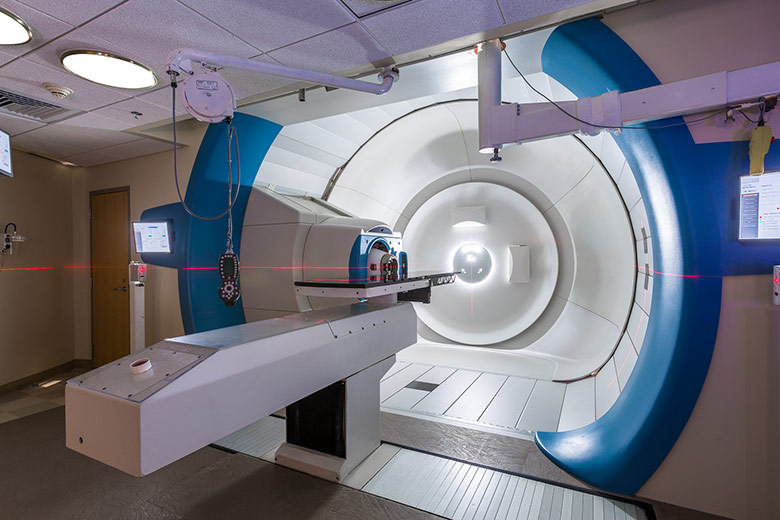
The University of Florida Health Proton Therapy Institute uses the latest in radiation oncology treatment technologies to deliver cancer-fighting therapy tailored to your unique needs. We have equipment available for many types of radiation therapy, including proton therapy, photon therapy and brachytherapy – all to help you beat cancer and live life to the fullest.
The expert radiation oncologists at the UF Health Proton Therapy Institute evaluate patients on a case-by-case basis. This helps to determine which treatment type and technology will achieve the best possible outcome for you.
Why Radiation Oncology Isn’t One-Size-Fits-All
Each person’s cancer diagnosis is unique and therefore the treatment for the cancer must be customized for the patient. For the best possible results, a tailored cancer treatment plan considers:
- The type of cancer you are facing
- The size and shape of the tumor
- The cellular makeup of your cancer
- The stage of your tumor
- Where it is located in the body
- Your current health
- Your personal health goals
- And more…
Because of this, radiation oncology is not a one-size-fits-all approach.
The UF Health Proton Therapy Institute delivers radiation to patients using many advanced technologies and tailored techniques. This allows us to precisely target tumors and help protect healthy surrounding tissue. Some patients may benefit from proton therapy while others require traditional photon (or X-ray) therapy. In some cases, we use a combination of both.
Our physicians use detailed imaging to determine the best course of treatment and craft a personalized cancer care plan for you. From there, treatments are tailored even further to target the size and shape of the tumor with as much precision and strength as possible. We use custom-made devices and other tools to help ensure you are in the ideal and accurate position during each treatment session.
Whatever the treatment method, our goal is always the same – to treat your cancer for the best possible outcome, with fewer side effects and better quality of life.
Our Advanced Radiation Therapy Technologies
One of the many benefits of choosing the UF Health Proton Therapy Institute is our ability to navigate a range of cancer treatment options. Whatever you need, you can feel confident you are receiving industry-leading care and support from a team of experts who put your well-being first. The radiation therapy technologies available include:
Proton Therapy
Pencil Beam Scanning
Pencil beam scanning, or IMPT (Intensity Modulated Proton Therapy), is a type of radiation that uses magnets to steer the proton beam, creating a customized, three-dimensional delivery shape.
Double Scattering
In double scattering proton therapy, scattering components and a range modulator alter the proton beam to achieve precise delivery and a customized energy burst.
Image-Guided Proton Therapy (IGPT)
With IGPT, radiographs of the patient are taken in real time as part of the daily treatment setup and are used to help radiation therapists determine if small positioning adjustments are needed to get the most precise treatment.
Cone-Beam Computed Tomography (CBCT)
IGPT can also be accomplished using built-in CT imaging scans taken in real time during daily treatment setup. The Cone-Beam Computed Tomography (CBCT) image provides a more detailed view of soft tissues to ensure accurate patient positioning and tissue changes.
Photon Therapy
3D Conformal Radiation Therapy
This photon (X-ray) based treatment utilizes three-dimensional, CT-based planning to create a treatment plan for a patient. Typically, a multileaf collimator (MLC) or custom blocks are used to match the 3D geometry of the target.
Intensity-Modulated Radiation Therapy (IMRT)
IMRT is delivered via a linear accelerator and is an advancement of 3D treatments and is preferred when targets are complex or closely abut critical organs that require more conformity than 3D treatments. These beams are set to different strengths, allowing the radiation to target cancer cells with less damage to healthy tissue.
Volumetric Modulated Arc Therapy (VMAT)
This is an advanced form of IMRT where a linear accelerator delivers radiation continuously while it rotates around the patient—thus creating an “arc.” This treatment also creates highly conformal treatment fields.
Stereotactic Body Radiation Therapy (SBRT)
SBRT is a highly precise, image-guided technique that delivers very high doses of radiation per fraction—typically 1 to 5 treatments to smaller, well-defined tumors outside of the brain. Protons or photons are used for this treatment.
Stereotactic Radiosurgery (SRS)
This is a highly precise radiation treatment that uses protons or photons. Typically, this is a single high-dose treatment to a brain lesion and may require multidisciplinary specialists as part of the care team.
Adaptive Radiotherapy
With this approach, physicians use advanced imaging to make treatment adjustments that account for changes in tumor shape, size or position over time. This is normally a brand new treatment plan. This approach is used for both proton and photon treatments.
Electron Therapy
Electron therapy is another type of particle therapy. These smallest atomic particles cannot penetrate too deep into the tissue so they tend to be utilized for superficial cancer (i.e., skin cancer).
Brachytherapy
High-dose brachytherapy
This is a type of internal radiation that uses a small catheter placed inside the tumor to deliver radioactive material, which is removed after a short session. With this treatment, no radiation stays in the body.
Personalized Care from a Multidisciplinary Oncology Team
Patients of the University of Florida Health Proton Therapy Institute have their care delivered by a multidisciplinary oncology team. From the first day of treatment to survivorship care, you will benefit from a dedicated team including:
- Radiation oncologists
- Medical physicists
- Dosimetrists
- Radiation therapists
- Nurse case managers, and more

All working together to design, deliver and monitor your treatment progress.
Before a patient starts treatment, each patient will undergo a treatment simulation. The treatment simulation uses advanced imaging and a smart dose-calculating software. This process allows the team to build a personalized treatment plan that provides the most effective care with the lowest risk of side effects.
At the heart of every team is the nurse case manager, who will remain your central point of contact for communication and support throughout treatment. If desired, the nurse case manager can also connect you to social support programs that provide meaningful care beyond the treatment room.
In short – we do not hand our patients a generic plan. Instead, we work together to build a personalized treatment plan that brings together the technology, technique and support you need. It is how we deliver on our mission to provide care that is harder on cancer and easier on you.
Why Patients Choose the UF Health Proton Therapy Institute
Since opening our doors in 2006, we have treated more than 12,000 patients from across the United States and 33 countries globally. We are a major clinical research facility whose expert cancer team is always working to make treatment more effective and more comfortable for our patients. As an NCI-Designated Cancer Center, you can rest assured you are receiving the highest quality and most advanced cancer care.
See why 98% of patents say they would “definitely recommend” us to a friend or family member.
Learn moreSchedule Your Cancer Treatment Consultation
A cancer diagnosis comes with a lot of decisions. Reach out to see if the University of Florida Health Proton Therapy Institute is the right choice for you. When you contact our radiation oncology clinic, a team member will be in touch within two days for a confidential, no-obligation consultation.
Get in touch